
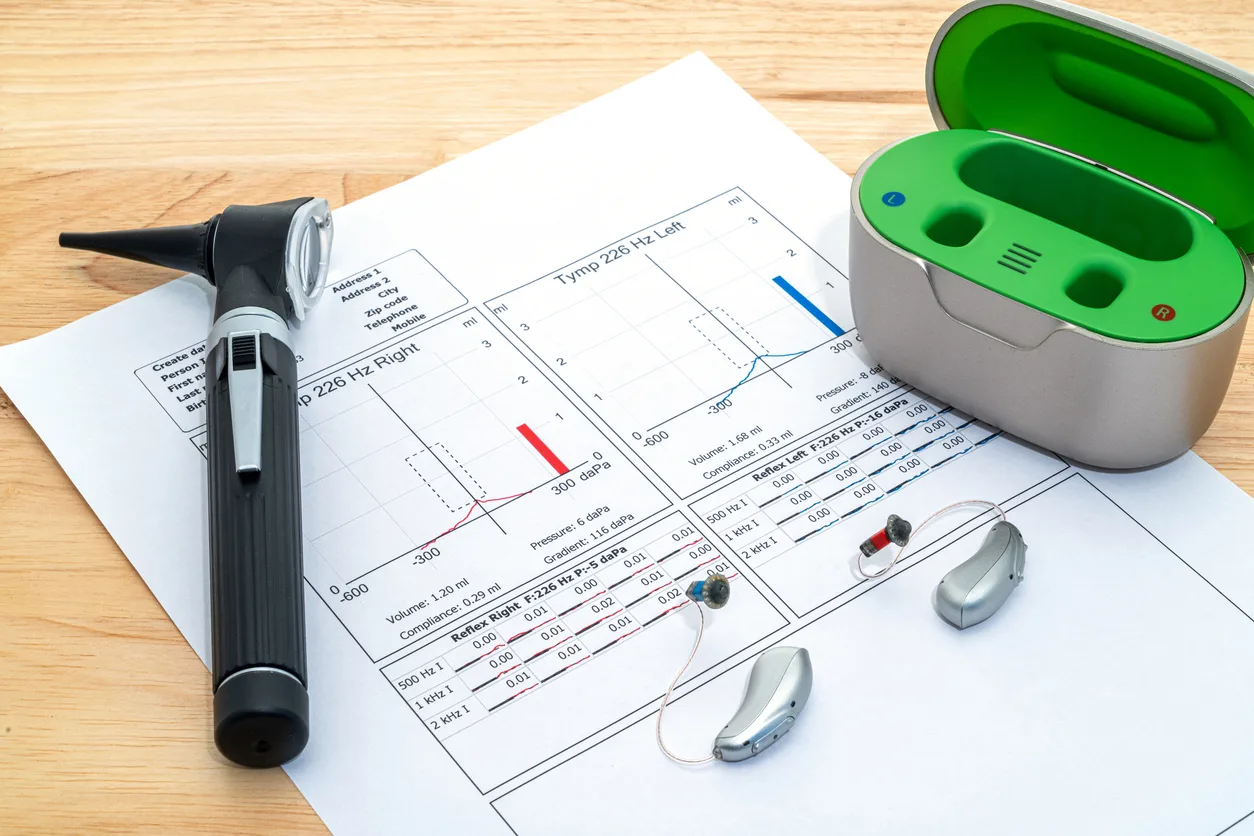
Hearing tests measure the extent of hearing loss someone may have; they also reveal when hearing aids should be considered. Keep reading to learn more.
The Hearing Test
While it may seem simple to diagnose hearing loss, it’s not that straightforward. Many levels of hearing loss exist. There are actually several different types of hearing tests that can be used to pinpoint hearing loss, but a pure-tone hearing test is the most common. The results of a pure-tone hearing test are reflected in a graph called an audiogram.
Pure-Tone Testing
Pure-tone hearing tests are most commonly used because of their accuracy, speed and efficiency at uncovering hearing loss. To conduct this type of test, a patient wears a set of headphones while a number of different sounds, from lowest to highest frequency, are played through them. The volume of the sounds played at different frequencies is also adjusted by the audiologist performing the test. The patient indicates when they can hear the sounds by raising their hand or pushing a button when the sound is heard.
The sounds that are heard create a “hearing profile” for the patient and are indicated on a graph called an audiogram. Your hearing threshold is plotted out across various frequencies, measured in hertz, on the audiogram. A hearing threshold indicates the softest sound (measured in decibels,dB) you are able to detect about 50% of the time, so there is room for you to miss some of the sounds and not be diagnosed with hearing loss.
Results by Age
The results of your hearing test as well as the determination if hearing loss is present, is measured by the softest sounds, dB, you can hear across various frequencies. Normal hearing for an average adult person is between -10 to 20 dB, this level would equate to the sound of someone whispering, or the rustling of leaves. Obviously age becomes a factor in hearing loss as it is more common to lose some hearing as you get older.
Normal levels of hearing may be common for children and young adults, but knowing the levels of hearing loss may help you decide if you need a hearing test. The levels of hearing loss include:
- Mild hearing loss: This is the ability to hear sounds between 20-40dB. This indicates a small degree of hearing loss and whispering or the rustle of leaves may not be heard. Conversation in a quiet room may not be difficult, but could pose an issue in a noisy environment or from a distance.
- Moderate hearing loss: This degree of hearing loss may cause difficulty hearing sounds like human voices, footsteps, or a toaster popping. Moderate hearing loss is only being able to hear between 40-70dB. When in a loud environment, communication will be difficult.
- Severe hearing loss: This type of hearing loss greatly affects a person’s ability to communicate with others. This is indicated by only hearing sounds between 70-95dB. Not hearing the phone ring, a doorbell, or a baby crying would fall under this category. People with severe hearing loss tend to read lips to understand what is being said to them.
- Profound hearing loss: This refers to very little or no hearing. It’s indicated by hearing only 95+dB. Not being able to hear conversation in a quiet room, or music played loudly through a stereo would indicate this type of hearing loss.
If you notice that you’re beginning to have difficulty hearing conversation in noisy environments, or are frequently asking people to repeat themselves, you should schedule a hearing test with a professional audiologist. If sounds come across as muffled, or you notice yourself turning up the volume on your TV or your phone, having your hearing tested is important.
It’s Time for Hearing Aids
If you suspect you may need hearing aids, the first thing you should do is schedule a hearing test with a hearing care professional. The team at Hearing Solution Centers is happy to assist you with a hearing test and information on hearing loss. An experienced audiologist should make the diagnosis of hearing loss and explain to you what can be done to help.
People with mild to severe hearing loss can benefit from the use of hearing aids. If hearing aids are prescribed to treat your hearing loss, an audiologist will explain your options and help find a hearing aid that matches your needs and your lifestyle.
Your hearing health is important to your entire lifestyle. Schedule a hearing test today with Hearing Solution Centers!